
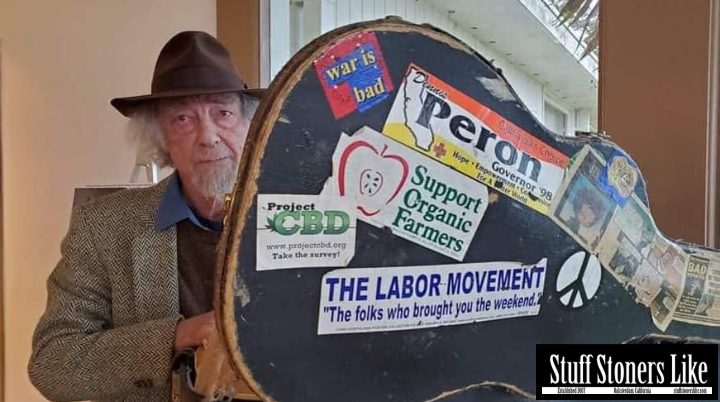
Fred Gardner has been writing about WEED longer than most of us have been smoking it. He also started a chain of anti-war coffeehouses for soldiers and co-founded Project CBD. Along the way, he stage-managed Jane Fonda’s anti-war tour and covered the medical MARIJUANA movement from day one. Today he lives right here in Alameda. Meet our first Bay Area local hero.
How I met Fred Gardner
A few years back, I was stumping for WEED at the art and wine festival in downtown Alameda. Then Fred walked up to my booth. I already knew his work, so I was beyond stoked. Somehow, he’s been putting up with me ever since.
Fred would ride his bike over with his guitar to entertain me and my kids. I’m honored to call him a friend. Recently, he sat down with me for a long, rambling, glorious oral history. Here are the highlights, mostly in his own words.
A Brooklyn kid in the McCarthy years
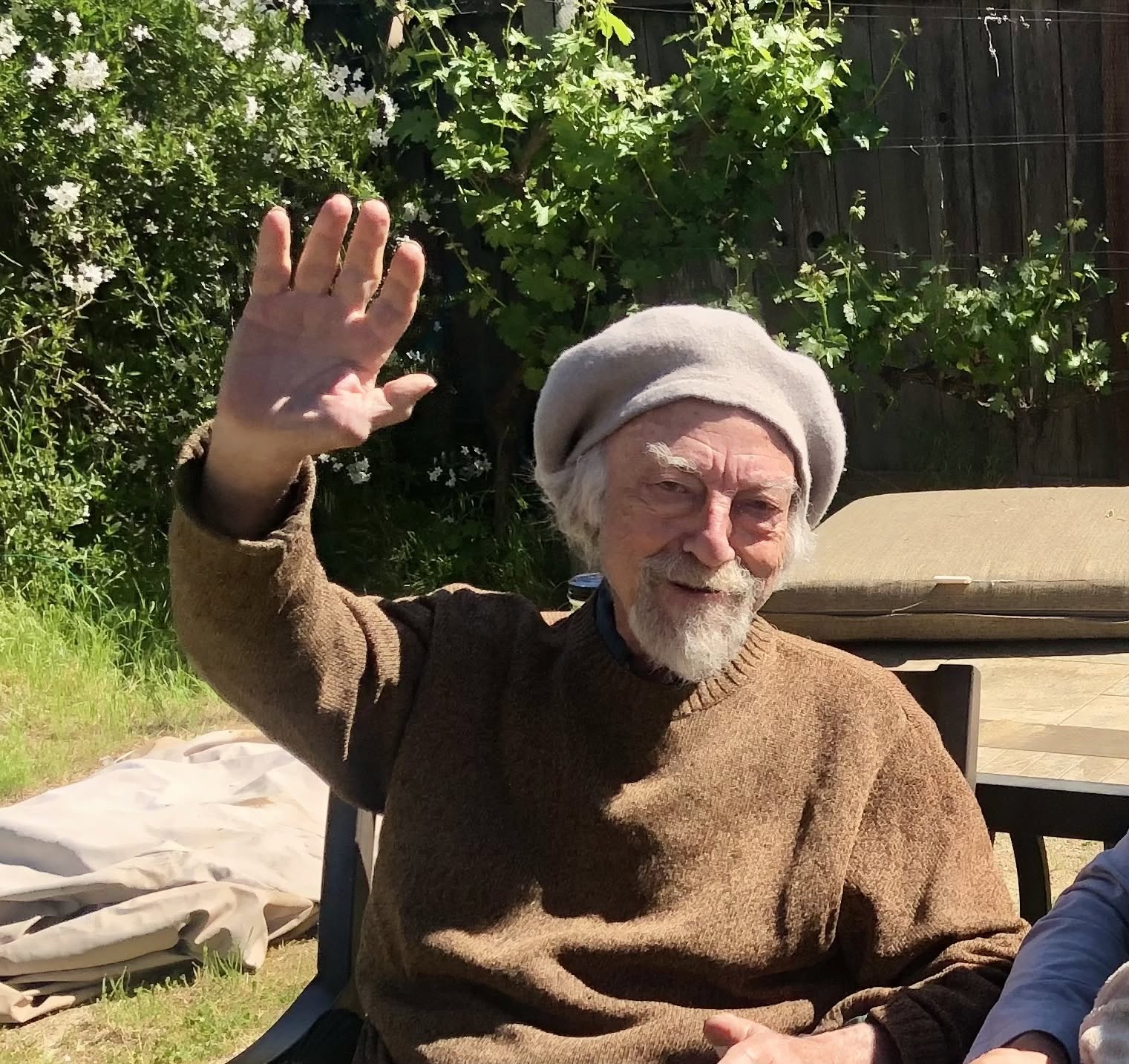
Fred was born in 1941 and grew up in Brooklyn. “It was a great place to grow up,” he told me. Kids played stickball and punchball, and the Good Humor truck came around in the evenings.
His mom was a public school teacher, and his dad was a sportswriter and a charter member of the newspaper guild. In 1950, she resigned rather than sign a loyalty pledge. Then the family moved to Manhattan. As Fred puts it, “my mom had a lot of dignity.”
Harvard, napalm, and a career change
Fred entered Harvard in 1959 and started out in biochemistry. However, he kept drifting to the Crimson, the student newspaper. Then came the day his organic chemistry professor boasted about inventing napalm. Fred stood up and walked out of the class. That was the end of his scientific career.
He graduated in 1963 and, by his account, went straight to work as an editor at Scientific American. Not long after, he was drafted. He joined the six-month Army Reserve program and reported to Fort Polk, Louisiana, on a Sunday in November 1963. Two days earlier, JFK had been shot.
The GI coffeehouse idea
Fred came out of the Army with a big idea. Place a coffeehouse among the bars and pawn shops of an army town, and anti-war soldiers could find each other. In 1967, he opened the UFO, a coffeehouse in Columbia, South Carolina, near Fort Jackson, with Donna Mickleson and Deborah Rossman. Fred remembers a cabaret director from San Francisco’s The Committee giving him practical advice, and Bill Graham sending Fillmore posters to decorate the place.
It worked. In 1968, Fred also helped start the United States Servicemen’s Fund with Dr. Howard Levy and Dr. Benjamin Spock. Meanwhile, soldiers hung out, jammed on the stage, and met one another. In 1968, GIs who met at the UFO staged a “pray-in” for peace on post. Because they wore their dress uniforms, the brass could not simply bust them. Reporters were there, and the story went national. That, in turn, helped spark a whole network of GI coffeehouses.
WEED was part of the story, too. Fred says millions of people started smoking in 1965 and 1966, and Vietnam was a major supply line. At the UFO, he asked soldiers not to smoke in the bathroom. “Come back to the staff house afterward,” he’d say, “and we can get to know each other.” Even then, he says, a seed in your pocket could mean prison time, and cops used that against activists.
Free the Army
In 1970, Jane Fonda and his old friend from The Committee asked Fred to stage-manage the FTA show, an anti-war revue built as an answer to Bob Hope’s USO tours. It played Fort Bragg and San Diego. Fred also wrote a song to link the skits together. He eventually quit over a sketch he found disrespectful to working-class sergeants.
He also covered the 1968 court-martial of 27 GIs charged with mutiny at the Presidio of San Francisco. His book on the case, The Unlawful Concert, came out from Viking in 1970.
From the Presidio to cannabis journalism
Over the years, Fred worked as an editor at Ramparts and co-wrote the screenplay for Michelangelo Antonioni’s Zabriskie Point. He also wrote for CounterPunch and the Anderson Valley Advertiser, and edited the UCSF medical center weekly. In 2003, he launched O’Shaughnessy’s, a journal for the Society of Cannabis Clinicians, at the urging of Dr. Tod Mikuriya. In 2010, he co-founded Project CBD with writer Martin A. Lee. The group helped create demand for CBD-dominant WEED.
Today, Fred runs Beyond THC. He is still chasing stories, too. When we talked, he was digging into where California’s 15 percent cannabis excise tax came from. His point: it is unprecedented to tax a medicine that way. That is Fred’s reporting in progress, so we’ll follow it.
More on Fred Gardner
Want to dig deeper? First, read the Fred Gardner Wikipedia page. Then, browse his recent work at Beyond THC. For the GI movement, check out the podcast episode By and For GIs.
Why Fred Gardner is a Bay Area hero
Fred has watched the civil rights, anti-war, and MARIJUANA movements unfold up close, and he has helped shape a few of them. Yet he still plays guitar, still writes songs, and still has a sense of humor about all of it. We’re lucky to have him in Alameda. When we wrapped, he was already planning to bring his guitar over so we could learn two of his songs.
This is the first story in our new Bay Area column on local heroes. Know someone we should feature? Tell us.
Special thanks to Julie Chiariello, co-owner and editor-in-chief of Skunk Magazine, for the photo of Fred and his guitar case.